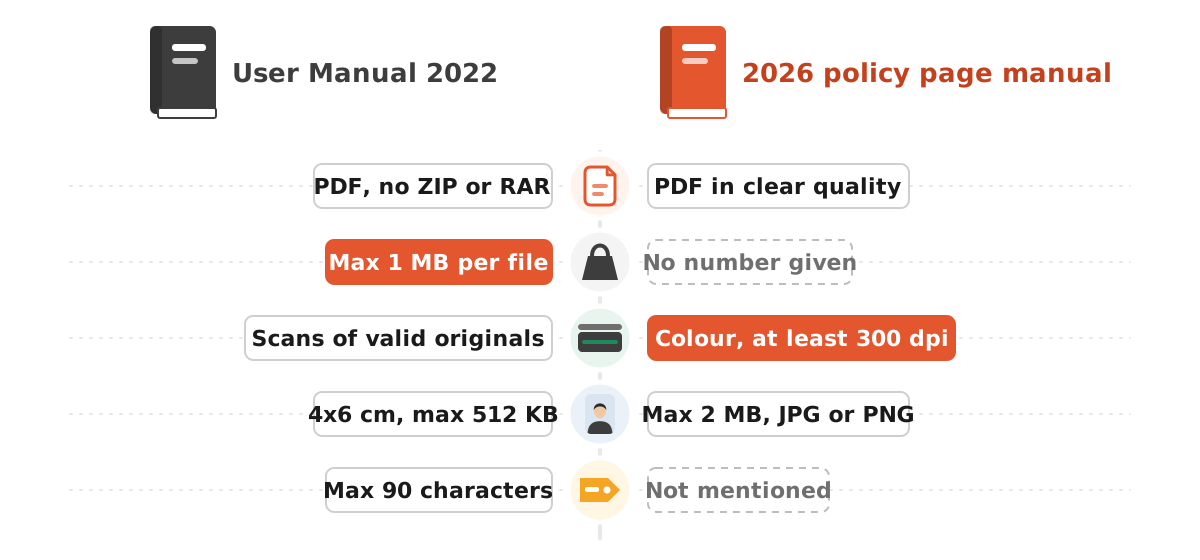
The LPDP upload requirements are written in two official manuals, and they do not say the same thing. The LPDP User Manual for the 2022 cycle asks for PDF documents of at most 1 MB each, no ZIP or RAR files, file names of up to 90 characters, and a 4x6 cm profile photo of at most 512 KB.
The user manual linked on the 2026 policy page (its cover still says Tahun 2025) asks for PDFs in clear quality, colour scans of at least 300 dpi, legalised diplomas and transcripts, and a profile photo of at most 2 MB in JPG, PNG, or JPEG. For document size it only says not to exceed the maximum, without printing a number.
So the limit shown in the upload form during your own cycle is what counts. The safe approach: scan well, keep each PDF under 1,000,000 bytes where you can, and match the form's validation message.
This guide is for Indonesian applicants wherever they are, including those scanning documents abroad. The Dokurapi tools mentioned below process files in your browser, on your device, without uploading them. If you want to know how that works, read how browser-based file tools work.
What the official LPDP sources actually say
Section "I. Mengunggah Dokumen" (uploading documents) of the 2022 manual lists eight numbered points plus twelve notes. The newer manual was rebuilt around the current application at beasiswalpdp-terintegrasi.kemenkeu.go.id, and its document step shows a short "Tips Upload Dokumen" box instead of numbered rules. Side by side:
| Rule | User Manual 2022 | Manual on the 2026 policy page |
|---|---|---|
| Document format | PDF in clear quality | |
| Archives | ZIP/RAR not allowed | Not mentioned |
| Document size | Max 1 MB per file | Must not exceed the maximum; no number given |
| Scan quality | Scans of valid original documents | Colour, at least 300 dpi |
| Diploma and transcript | Enter the diploma number when uploading | Must be legalised |
| File name length | Max 90 characters | Not mentioned |
| Profile photo | 4x6 cm, face to half body, max 512 KB | Max 2 MB, JPG, PNG, or JPEG |
The 2022 manual also says KTP (ID card) and KK (family card) scans must be of the originals, that you can re-upload after an upload error, and that each successful upload produces a download link. If your previous degree was completed abroad, it asks for the diploma number to be the decree (SK) number printed on your Indonesian equivalency (penyetaraan) document.
One table in the newer manual contains the note "Upload file Format PDF, max 8Mb", but it sits in the Email row of a personal data table, so it reads like a copy error rather than the document limit. We do not treat it as one. The LPDP general policy page itself only says applicants complete and upload the required documents in the application, with details in each programme's booklet.
Ready to try it? The tool is free and runs in your browser.
Open the Compress PDF to 1 MB toolWhich documents the 2026 application asks for
The newer manual shows the document step for a master's (S2) applicant. The fields marked as required in that screenshot are:
- KTP (identity card).
- Diploma (D4/S1), original or legalised, or an SKL (graduation statement letter).
- Transcript (D4/S1), original or legalised, not a professional programme transcript.
- The required foreign language certificate, still valid (original).
The same screen lists further slots that only apply in some situations, such as a stamped statement that you did not falsify documents in an earlier LPDP registration, and proof of a study programme's BAN-PT accreditation.
The 2026 booklets add timing rules. The STEM Industri Strategis booklet and the SHARE booklet, both published on 30 June 2026, ask for English certificates valid within the last two years counted up to 22 September 2026 (the appeal result date) and recommendation letters signed no more than one year before the registration month.
Two practical points follow. Every slot takes its own file, so a transcript must be one PDF, not three loose images. And legalised copies usually carry stamps and signatures in coloured ink, which a colour scan keeps visible. Your programme's booklet is the final list, because requirements differ by programme and by affirmation track.
What changed for the 2026 intake
The official Phase 2 2026 announcement lists changes that affect your document list:
- The Personal Statement essay was dropped and replaced with a structured "Profil Diri" (self profile).
- The commitment essay stays, with a maximum of 1,500 words.
- An English certificate is no longer required if you hold an Unconditional LoA that meets LPDP's rules.
- The Duolingo English Test was added alongside TOEFL ITP/iBT, PTE, and IELTS.
The announcement also asks applicants not to submit in the last hours before the deadline, to avoid system problems. That advice matters more if you are in a different time zone: the 2026 Phase 2 window on the policy page ran from 30 June to 31 July 2026, and a deadline set in Jakarta time arrives earlier than you might expect if you are working from Europe or the Americas.
One line on the policy page deserves attention: an appeal (sanggah) after the administrative selection cannot replace information in the documents you submitted at registration. A blurry or wrong file cannot be fixed later. The only time to get it right is before you submit.
How many bytes is "1 MB"?
There are two conventions. Decimal: 1 KB = 1,000 bytes and 1 MB = 1,000,000 bytes. Binary: 1 KB = 1,024 bytes and 1 MB = 1,048,576 bytes. Windows File Explorer uses the binary count but still labels it "KB", so a file of exactly 1,000,000 bytes shows as roughly 977 KB. A file that Explorer reports as 990 KB is about 1,013,760 bytes, which is over a decimal 1 MB limit.
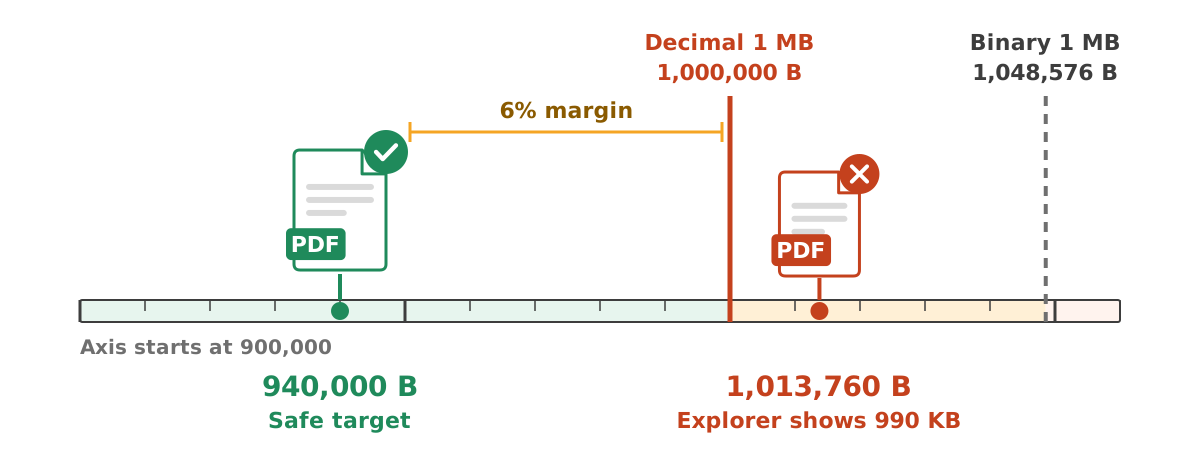
Dokurapi always counts 1 KB as 1,000 bytes and then takes 6% off the target as a safety margin. For a 1 MB target, the tool aims for at most 940,000 bytes, which passes under either convention. A few kilobytes of headroom costs nothing visible and removes the guesswork. The Check PDF Size tool shows exact bytes, so you never have to trust a rounded label. There is more on this in our guide to checking file size before uploading.
Scan quality versus file size: the 300 dpi question
The newer manual's request for colour scans of at least 300 dpi pulls against any small size limit. A colour A4 page at 300 dpi is about 2,480 by 3,508 pixels, which is a lot of image data for one page, and a multi-page transcript multiplies it.
Be clear about what compression does here. The Compress PDF tools re-render each page as an image at 1.2, 1.0, 0.82, or 0.68 times the page's own size. PDF pages are measured in points, 72 to the inch, so even the sharpest setting gives about 86 pixels per inch, roughly 714 by 1,010 pixels for an A4 page. That keeps a document readable on screen, but the result is no longer a 300 dpi scan.
So the order matters:
- Scan in colour at 300 dpi and let your scanner or scanning app save a compressed PDF. Many offer a quality or "small file" setting.
- Measure the result. If it fits the form's limit, upload it unchanged.
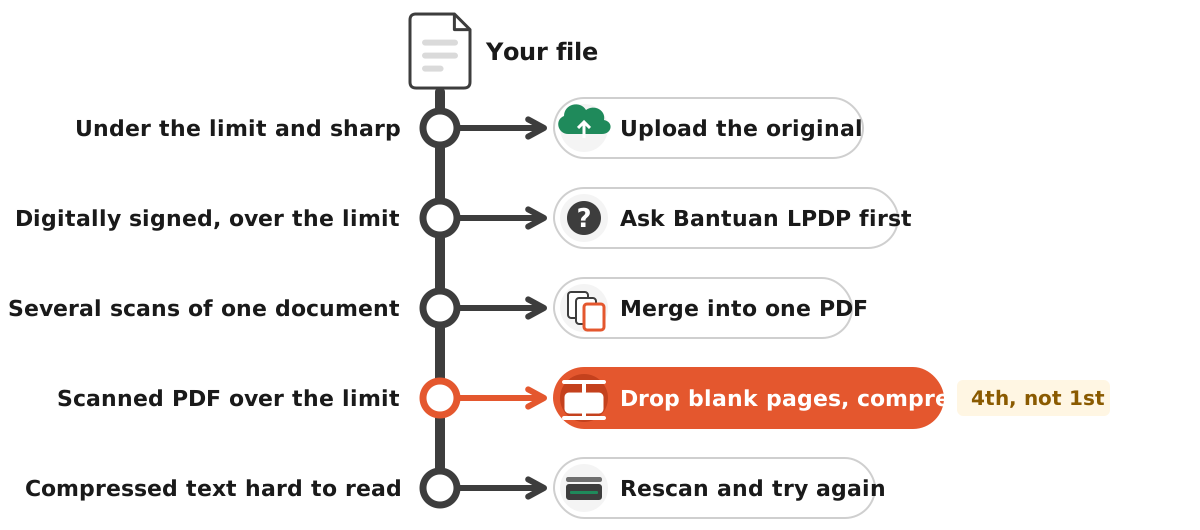
- If it does not fit, try a stronger compression setting in the scanner app first, still at 300 dpi, and remove blank pages.
- Only if that fails, use the compressor, accept that the output is a lower-resolution copy, and check that every number is readable.
If you photograph documents instead of scanning them, Photo to PDF places JPG and PNG files into the PDF without re-encoding them, and Merge PDF copies pages as they are. Neither lowers resolution, but neither makes a file smaller either.
Step by step: preparing LPDP PDFs with Dokurapi
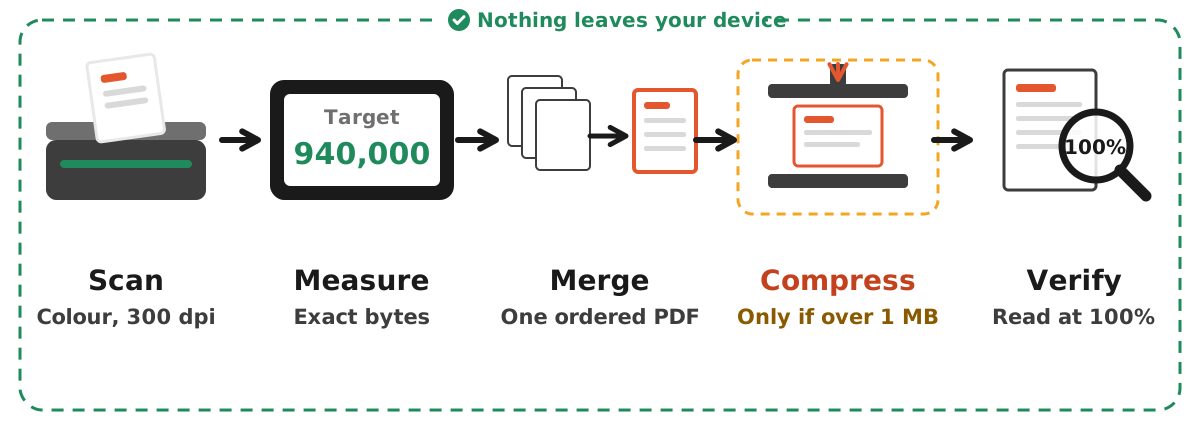
- Scan. Colour, 300 dpi, page flat and evenly lit, one document per file.
- Measure first. Open Check PDF Size. It shows exact bytes and page counts for up to 20 files at once and flags PDFs that look damaged. If a file is already under the limit and sharp, leave it alone.
- Merge multi-page scans. A transcript scanned page by page should become one ordered PDF. Use Merge PDF, then check the page order.
- Compress only if needed. Open the Compress PDF to 1 MB tool. It tries render sizes and JPEG qualities from the sharpest downward and stops at the first result under the safe target.
- Read the status. You will see the original size, the output size in bytes, and whether the safe target was reached. A file that still misses the target is reported as such, not as a success.
- Check legibility at 100% zoom. Diploma number, GPA, grades, dates, and stamps must all be readable.
- Rename. Something like
Transcript_S1_Rina_Pratiwi.pdf(30 characters) is clear and well under 90. - Upload, then download it back from the link the application shows, and confirm it is the right file.
Because compressed pages are re-rendered as images, text in the output can no longer be selected or searched, and any embedded digital signature is removed. There is more detail in our guide to compressing a PDF to 1 MB, and in our notes on merging PDFs for submissions.
The profile photo
The 2022 manual wanted a formal 4x6 cm photo showing the face to half body, at most 512 KB. The newer manual sets a maximum of 2 MB in JPG, PNG, or JPEG. A photo straight from a phone camera can be larger than either, so crop first, then compress if needed.
- The blue background and red background ID photo tools offer a 4:6 crop, replace the background in your browser, and save a JPEG 600 pixels wide. Neither LPDP manual names a background colour, so only use one if your form asks for it, and check the edges of hair and shoulders afterwards.
- For the 2 MB limit, Photo to 1 MB aims for 940,000 bytes. For the older 512 KB rule, Photo to 500 KB aims for 470,000 bytes, still under 512,000.
A formal photo is judged by a person, not only by the validator. A sharp, evenly lit, front-facing photo at a modest file size is better than a heavily compressed one with blocky edges.
Troubleshooting
Text turned blurry
1 MB is generous for a one-page diploma but tight for an eight-page colour transcript, which leaves roughly 117 KB per page. Pushing quality lower makes it worse. Start from a clean scan instead: page flat, even light, no shadows, blank pages removed, and the scanner's own compression at 300 dpi. If a colour 300 dpi transcript truly cannot fit the form's limit, ask LPDP's official help centre how they want it handled rather than guessing.
Still over the limit
Remove blank or duplicate pages and check whether the original scan resolution is far above 300 dpi. Do not split one document across several files unless the form gives you separate slots. Our guide on what to do when a compressed file is still too big covers more cases.
The output is bigger than the input
This happens with very efficient originals, such as 1-bit black-and-white scans from an office copier. Re-rendering them as JPEG adds bytes. Keep the original.
Digitally signed transcripts and certificates
Many universities, in Indonesia and abroad, now issue e-transcripts and certificates as signed PDFs. Render-based compression strips the signature even though a printed QR code stays visible. If the original is under the limit, upload it unchanged. If it is too large, ask the help centre whether a compressed copy is acceptable before you use one.
Pre-submit checklist
- Every PDF under the limit the upload form states; under 940,000 bytes for a 1 MB limit.
- Scans in colour and legible, at 300 dpi where the file size allows.
- No ZIP or RAR files.
- Short, plain file names, far below 90 characters.
- Diploma and transcript original or legalised, diploma number legible (or the equivalency SK number for a foreign degree).
- Transcript complete, GPA visible, pages in order.
- Language certificate still valid under your booklet's date rule, if one is required for you.
- Recommendation letters signed within the period your booklet sets.
- Profile photo in JPG, PNG, or JPEG and under 2 MB.
- Every file downloaded back from the application and checked.
Honest limits
Dokurapi shrinks and measures files. It is not affiliated with LPDP and cannot guarantee that the application accepts a file. The current form, the current booklet, and the verifier's reading of your documents decide that.
Our view: aim for the most legible file under the limit, not the smallest one. A 300 KB blurry transcript is no safer than a 900 KB sharp one; both pass the size check, only one passes verification. Your files stay in your browser throughout, so delete leftover copies from your Downloads folder when you are done, especially on a shared computer.
Frequently asked questions
What is the maximum file size for LPDP document uploads?
Can I upload LPDP documents as JPG or ZIP files?
How long can an LPDP file name be?
Does LPDP require scans at 300 dpi?
What size can the LPDP profile photo be?
Do my diploma and transcript need to be legalised?
How recent must my English certificate and recommendation letter be?
What diploma number do I enter if my degree is from abroad?
Can I fix a wrong document during the appeal (sanggah)?
Does compressing with Dokurapi remove digital signatures or lower the resolution?
Sources
- LPDP scholarship registration User Manual 2022 (document upload section)
- LPDP registration User Manual linked on the 2026 policy page (cover: Tahun 2025)
- LPDP scholarship general policy 2026
- LPDP 2026 booklet: Beasiswa STEM Industri Strategis
- LPDP 2026 booklet: Beasiswa SHARE
- LPDP announcement: Phase 2 2026 registration opens
- Bantuan LPDP (official help centre)
Need help?Result not quite right, or unsure about a form rule? Ask Dokurapi support on WhatsApp. Please do not send personal documents in chat.
Chat on WhatsApp