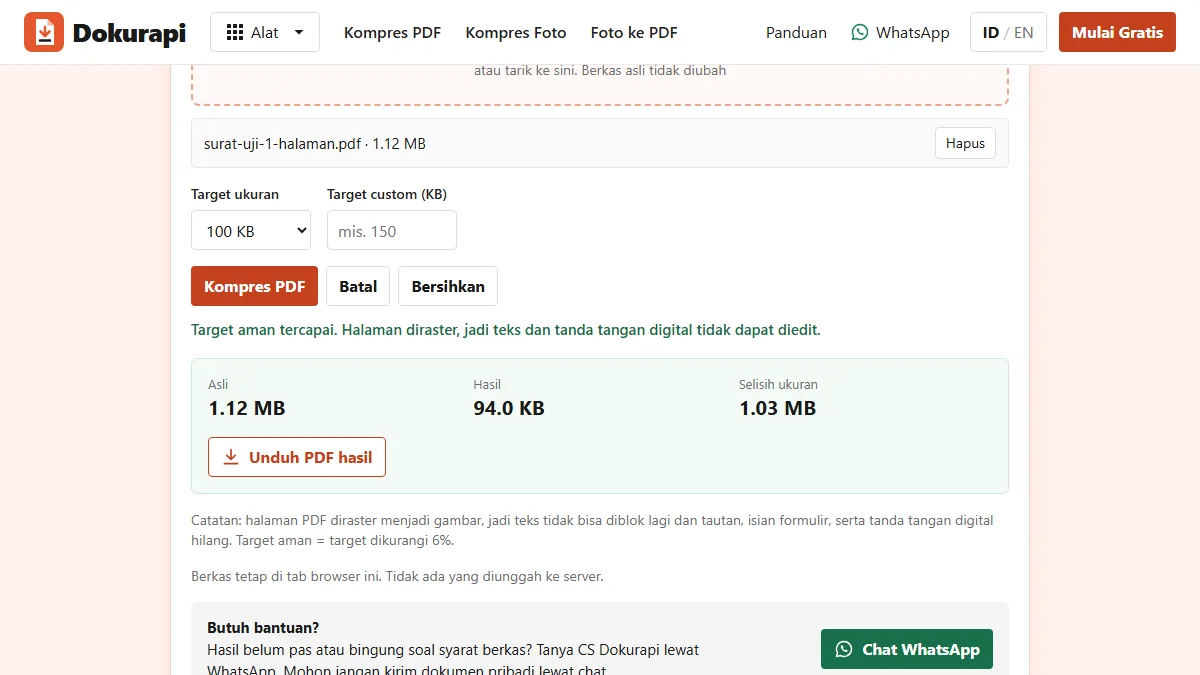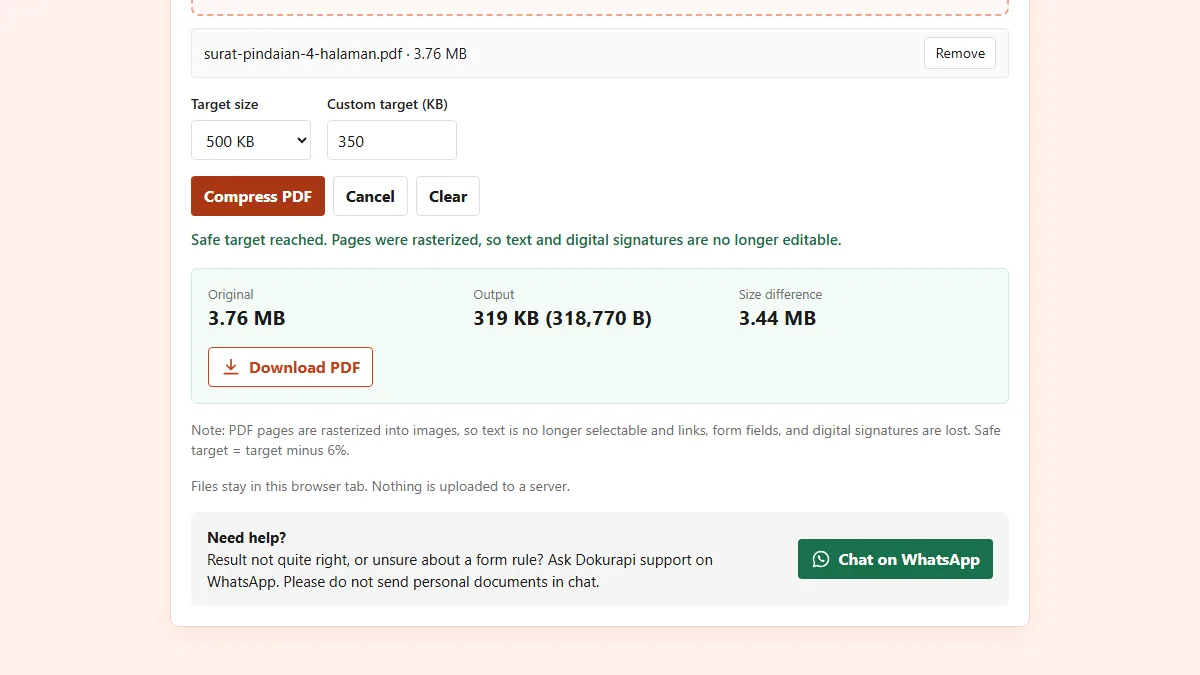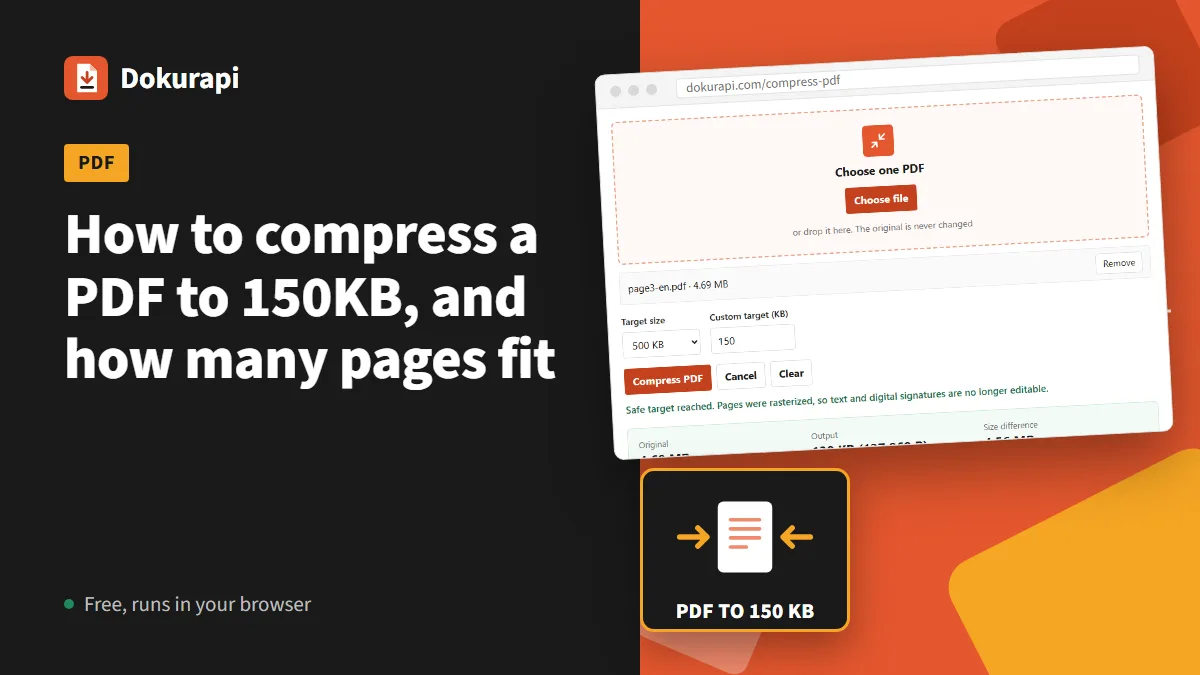
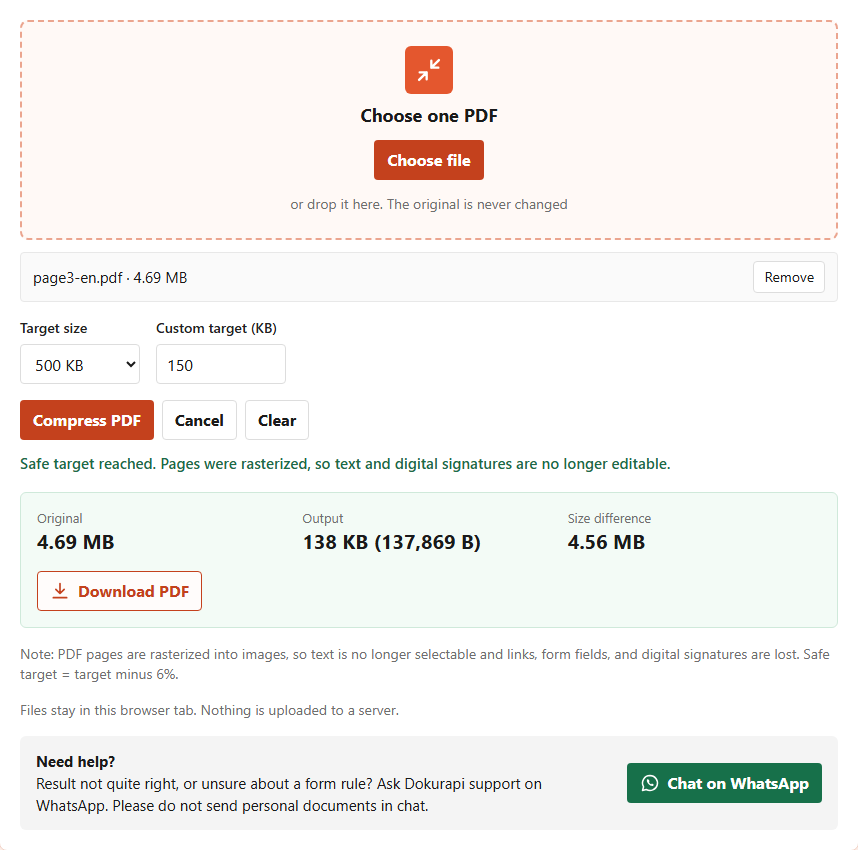
To compress a PDF to 150KB, open Dokurapi's free Compress PDF tool, choose the file, type 150 in the Custom target (KB) box, press Compress PDF, and check the Output line before you press Download PDF. The tool aims 6% below your number, so a 150 KB target means a file of at most 141,000 bytes. Your file is processed inside the browser tab and is not uploaded. In our test a 4.69 MB three page scan came out at 137,869 bytes in under ten seconds.
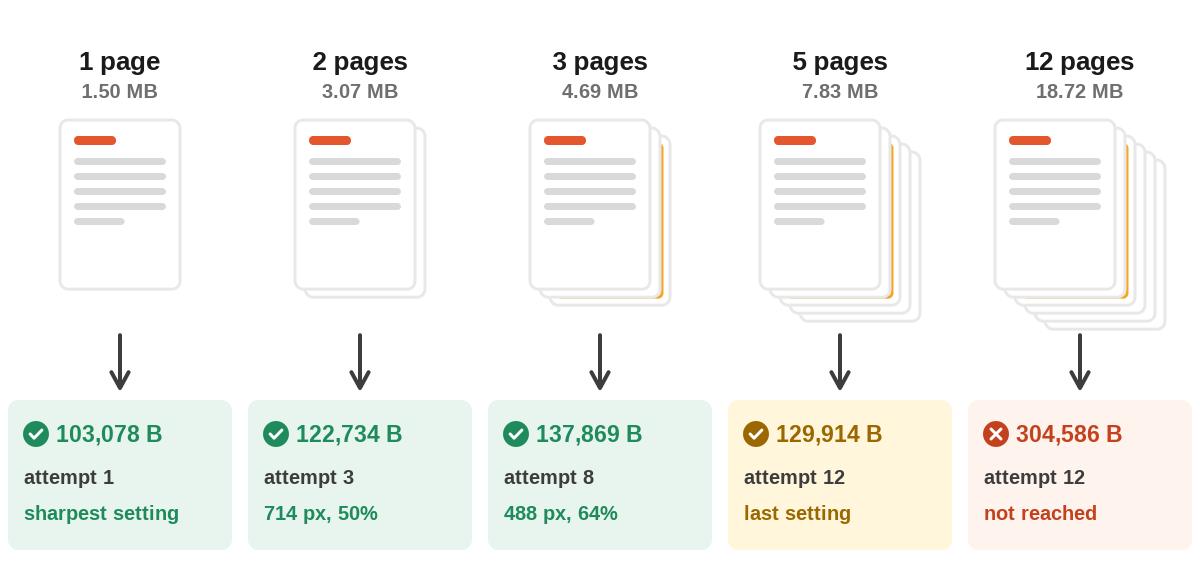
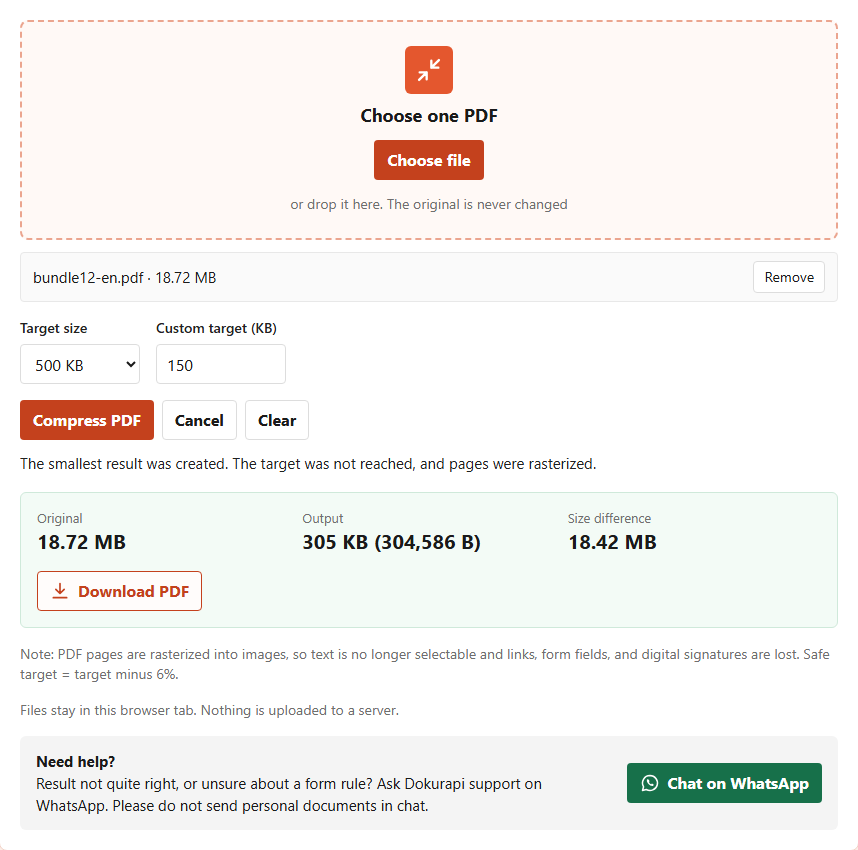
A 150 KB limit is more generous than it looks. In our tests one, two and three page scans all fitted, five pages fitted only on the tool's last and smallest setting, and twelve pages could not get below 304,586 bytes. This guide walks through the steps, the search the tool runs, the real numbers from five test files, how the pages look afterwards, and what to change when your file will not fit. If your form asks for a different size, see our guides to 100 KB, 200 KB or 50 KB.
Steps to compress a PDF to 150KB
You do not need an account or an app. The tool creates a new copy and leaves the file you picked untouched, but keep the original anyway, because you may want to try again with fewer pages.
- Check the size and the page count. Our PDF size checker shows both in a second. Page count matters more than the starting size, as the test results below show.
- Open the Compress PDF tool and choose one PDF. The preset menu offers 100 KB and 200 KB but not 150 KB, so you will use the custom box.
- Type 150 in the Custom target (KB) box. A number in this box always wins over the preset menu, even when the menu still shows 500 KB.
- Press Compress PDF and wait for the result box. One to three pages take a few seconds. A long bundle can take close to a minute, because the tool may try all twelve settings.
- Read the status line and the Output figure. Green text saying the safe target was reached means the file is at or under 141,000 bytes. Grey text saying the target was not reached means you got the smallest file the tool could make.
- Open the downloaded file and zoom in. Check names, numbers, dates and stamps on every page before you upload it.
Ready to try it? The tool is free and runs in your browser.
Open the Compress PDF toolHow the tool searches for a 150KB file
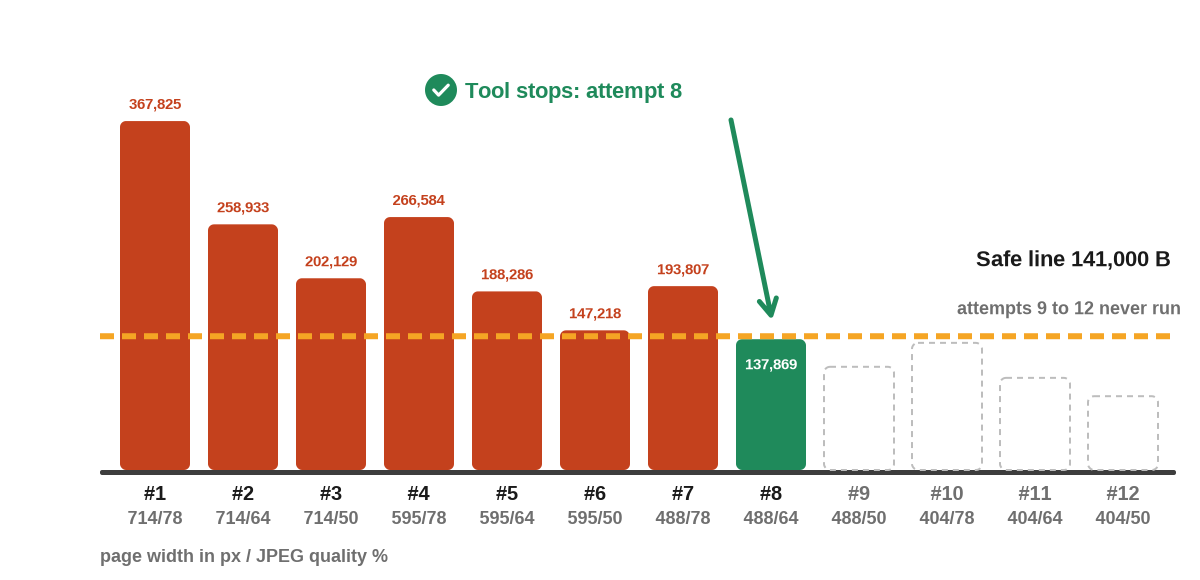
The compressor does not pick one setting and hope. It draws each page as a picture, saves that picture as a JPEG, rebuilds the PDF and weighs the whole file. It can make up to 12 attempts, made from four page widths and three JPEG qualities. The widths are 1.2, 1, 0.82 and 0.68 times the page size, which is 714, 595, 488 and 404 pixels across an A4 page. The qualities are 78%, 64% and 50%, the value handed to the browser's own image encoder as described in MDN's toDataURL reference.
The search begins with the sharpest pair and walks down. The first attempt that lands at or under the safe line wins, and the tool stops there. For 150 KB the safe line is 150 x 1,000 x 0.94 = 141,000 bytes. The tool counts 1 KB as 1,000 bytes, the decimal convention explained by NIST.
Our three page scan needed eight attempts. Attempts 1 to 7 weighed between 367,825 and 147,218 bytes, so all were too heavy. Attempt 8, 488 pixel pages at quality 64%, came in at 137,869 bytes, and attempts 9 to 12 never ran. Attempt 6 is worth a look: it was only 6,218 bytes over the line, so a slightly lighter scan would have kept the sharper 595 pixel width. When none of the 12 attempts fits, the tool keeps the smallest one and says the target was not reached. The same search runs for any number you type, as our guide to a specific size explains.
What the live tool returned in our tests
We built five synthetic scans that hold no personal data: off white paper with uneven light, scanner noise, a heading and lines of sample text, each page saved as a high quality JPEG inside a PDF. That is close to what a phone scanner app or an office copier produces. Each file went through the live tool with 150 typed as the custom target.
| Test file | Original | Result | Attempt used | Status in the tool |
|---|---|---|---|---|
| 1 page form | 1.50 MB | 103,078 B | 1: 714 px, 78% | Safe target reached |
| 2 page form | 3.07 MB | 122,734 B | 3: 714 px, 50% | Safe target reached |
| 3 page bundle | 4.69 MB | 137,869 B | 8: 488 px, 64% | Safe target reached |
| 5 page application | 7.83 MB | 129,914 B | 12: 404 px, 50% | Safe target reached on the last attempt |
| 12 page bundle | 18.72 MB | 304,586 B | 12: 404 px, 50% | Target not reached |
Two things stand out. First, the one page form kept the sharpest setting the tool has, 714 pixels at 78%, and still had 37,922 bytes to spare. Second, the five page file fitted but only just: the eleventh attempt weighed 161,821 bytes, and only the twelfth and smallest one got under the line. The twelve page bundle was more than twice the limit even at that smallest setting. The starting size did not decide any of this, because every file was several megabytes. The number of pages did.
How many pages fit in 150KB
A scanned PDF is a stack of pictures, one per page, plus a little PDF structure. Compressing it means deciding how many bytes each picture may use. Divide the 141,000 byte safe line by the page count and you get the budget for one page.
| Pages | Budget per page | Sharpest setting that fitted in our tests | What to expect |
|---|---|---|---|
| 1 | 141,000 B | 714 px, 78% | Sharp, close to a normal scan |
| 2 | 70,500 B | 714 px, 50% | Good, slight softness |
| 3 | 47,000 B | 488 px, 64% | Readable, letter edges soften |
| 5 | 28,200 B | 404 px, 50% | Readable at normal zoom, small print suffers |
| 12 | 11,750 B | none | Does not fit with this method |
At the smallest setting a page of our test text needed about 26,000 bytes. That is the floor for this kind of scan, so roughly five pages is the practical ceiling for 150 KB. Pages with photos, colour stamps or a dark background need more, and plain typed pages on clean white paper need less. Treat the table as a guide for typical phone or copier scans, not as a promise for every document.
How a page looks at 150KB
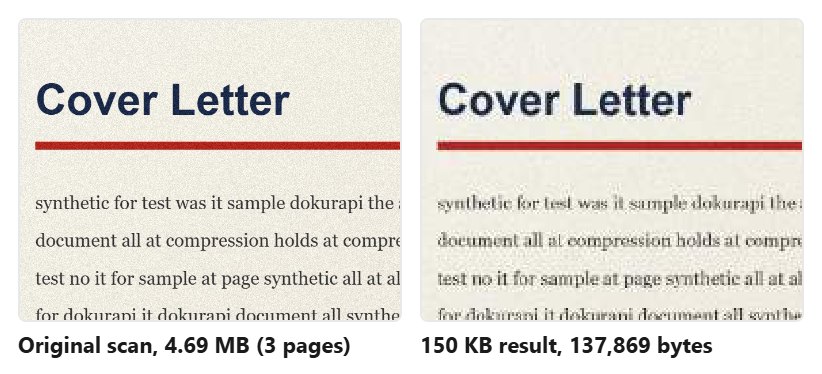
How sharp the result looks depends on the pages, not on the number 150. Our one page form kept a 714 pixel wide image at quality 78%, which looks almost like the original on a laptop screen. The three page bundle dropped to 488 pixels at 64%, a little wider than a phone screen. Headings and body text stayed easy to read, but the edges of letters softened and the paper texture turned slightly blotchy.
The comparison below shows the same corner of the first page before and after. Zoom your own result to 100% and look at the parts a reviewer must read: ID numbers, dates, names and any signature or stamp. If you have to squint, the person checking the upload will too.
Remember that the tool always picks the sharpest attempt that fits, so there is no hidden better setting to find by clicking again. If you need more detail, change the input: crop empty margins before scanning, scan only the pages the form asks for, and keep the page flat and evenly lit. Shadows, a grey desk around the page and a skewed angle all cost bytes without adding anything the reviewer needs.
When a PDF will not go under 150KB
If the status line says the target was not reached, pressing the button again will not help, because the tool already tried its smallest setting. The fix is fewer pages or lighter pages. Work through this list in order:
- Remove pages the form does not ask for. Cover sheets, blank backs and instruction pages all cost bytes. Our guide to deleting PDF pages shows how.
- Split the bundle if the portal has several upload fields. Each file then gets its own 150 KB budget. Splitting a PDF takes a minute and also runs in the browser.
- Rescan in grayscale on white paper. Colour, shadows and a dark background add bytes. Our scanning guide covers lighting and cropping.
- Check whether 150 KB is per file or for the whole upload. Some forms set a small limit for a single declaration and a larger one for supporting documents.
Our twelve page bundle shows the scale of the problem. At the smallest setting it weighed 304,586 bytes, so it would need to lose more than half its pages to fit. Splitting it into three files of four pages each would put every file comfortably under the line. If you have tried all of this and the file is still too big, our checklist for a compressed file that is still too big covers rarer causes, such as oversized page dimensions.
150KB, 0.15MB and how portals count
Forms write the same limit in different ways: 150 KB, 150 kb, 0.15 MB, or sometimes a number in bytes. In decimal units, 150 KB is 150,000 bytes and 0.15 MB. Some systems count 1 KB as 1,024 bytes instead, which makes 150 KB equal to 153,600 bytes. The tool's safe line of 141,000 bytes sits under both readings, and that margin also covers portals that round the size or add a little overhead when they store a file.
So read the exact byte count in the Output line, not only the rounded KB figure. A result of 137,869 bytes reads as 138 KB in the tool and passes either way of counting. If a form only says "maximum 150 KB" without more detail, aim for the safe target and you will not have to guess. Our explainer on how KB and MB are counted puts both conventions side by side with more examples.
One more detail trips people up: some operating systems show file sizes in binary units while the portal uses decimal units, or the other way round. If your file manager says 146 KB and the portal says the file is too big, the two may simply be counting differently. The byte count is the only figure both sides agree on.
Text PDFs from Word need a different approach
Everything above is about scans. A PDF exported from Word, Google Docs or an online form stores text as text, not as a picture, and is often well under 150 KB already. In that case the tool tells you the file is already under the target and suggests keeping the original, which keeps the text sharp and searchable.
When a text PDF is over 150 KB, the weight usually comes from an embedded image such as a large logo, a photo or a scanned signature. Compressing the whole file with this tool would turn every page into a picture, which blurs the text and removes links. It is better to shrink that image in the source document, export the PDF again, and only then check the size. If you plan to merge several small files into one upload, read our note on merging PDFs for submissions first, since the merged file adds the sizes together.
Before you upload the 150KB file
Do one last check. Confirm the byte count in the tool's Output line, then open the file in a PDF reader and scroll through every page. Make sure the order is right and no page came out blank; our guide to checking PDF page order lists what to look for. Rename the file the way the form asks, since some portals reject spaces or long names, and keep the compressed copy next to the original in case the portal rejects it.
Remember what the tool changed. The pages are now images, so text cannot be selected, and links, form fields and digital signatures are gone. If the portal needs a digitally signed PDF, compress first and sign afterwards, or ask the institution how it handles signed files. Privacy stays simple: the file was processed in your own browser, as our explainer on how browser tools work describes, and nothing was sent to a server. The same steps work in Chrome or Safari on a phone; see our tips for compressing a PDF on a phone.
Frequently asked questions
How do I compress a PDF to 150KB for free?
How many pages can fit in a 150KB PDF?
Why is there no 150KB option in the preset menu?
Is 150KB the same as 0.15MB?
Why did the tool make my file smaller than 150KB?
Will the text in my PDF still be selectable?
Is my document uploaded to Dokurapi?
What if my PDF is still over 150KB after compressing?
Sources
Need help?Result not quite right, or unsure about a form rule? Ask Dokurapi support on WhatsApp. Please do not send personal documents in chat.
Chat on WhatsApp