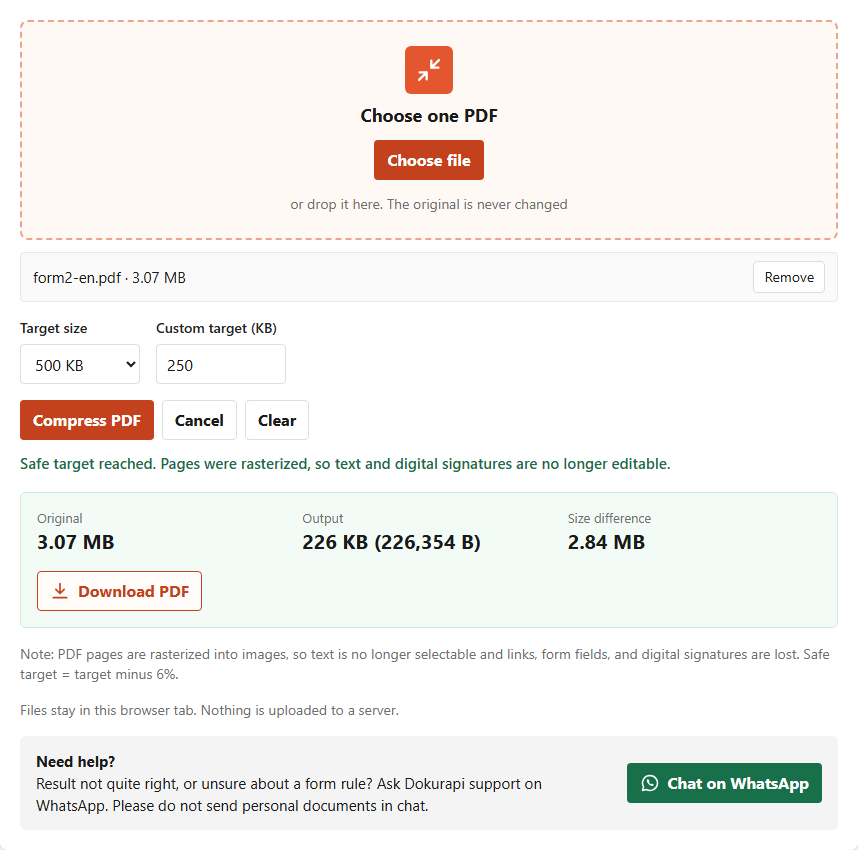
To compress a PDF to 250KB, open Dokurapi's free Compress PDF tool, choose your file, type 250 in the Custom target (KB) box, press Compress PDF, and read the Output line before you download. The tool aims 6% under the number you type, so a 250 KB target produces a file of at most 235,000 bytes. Everything happens in your browser tab, so the document is not uploaded anywhere. In our tests a 3.07 MB two page form came out at 226,354 bytes on the tool's sharpest setting.
250 KB is a comfortable limit for scans. Every file of up to five pages fitted on a sharp or middle setting, an eight page bundle fitted on the smallest setting, and only the twelve page bundle stayed over the line at 304,587 bytes. Below you will find the steps, the search the tool runs, the full results table, a grid that compares 250 KB with 150, 200 and 300 KB on the same files, a close look at page quality, and what to do when the file will not fit. For other limits see our guides to 200 KB, 300 KB and 150 KB.
Steps to compress a PDF to 250KB
You need a browser and the PDF, nothing else. No account, no app, and no watermark is added. The tool writes a new file and leaves the one you picked as it was.
- Look at the page count first. Our PDF size checker shows the size and the number of pages. For scans, pages decide the result far more than megabytes do.
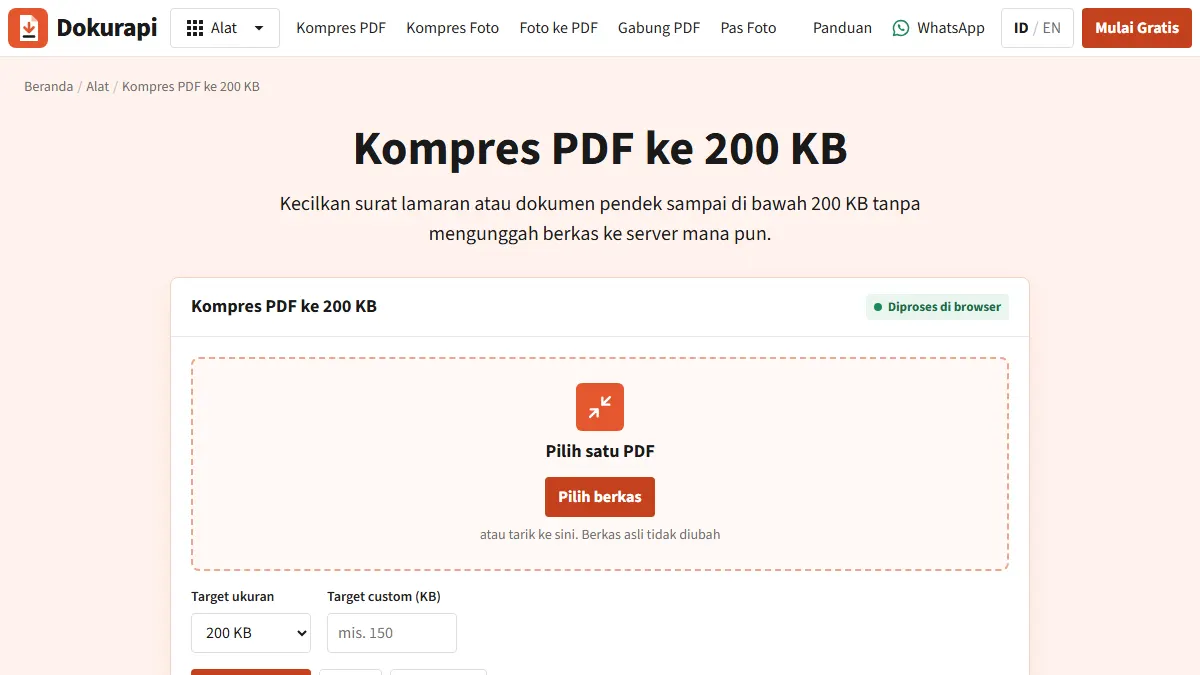
- Open Compress PDF and choose one file. The preset list offers 100 KB, 200 KB, 500 KB, 1 MB and 2 MB. 250 KB is not on it, which is why the custom box exists.
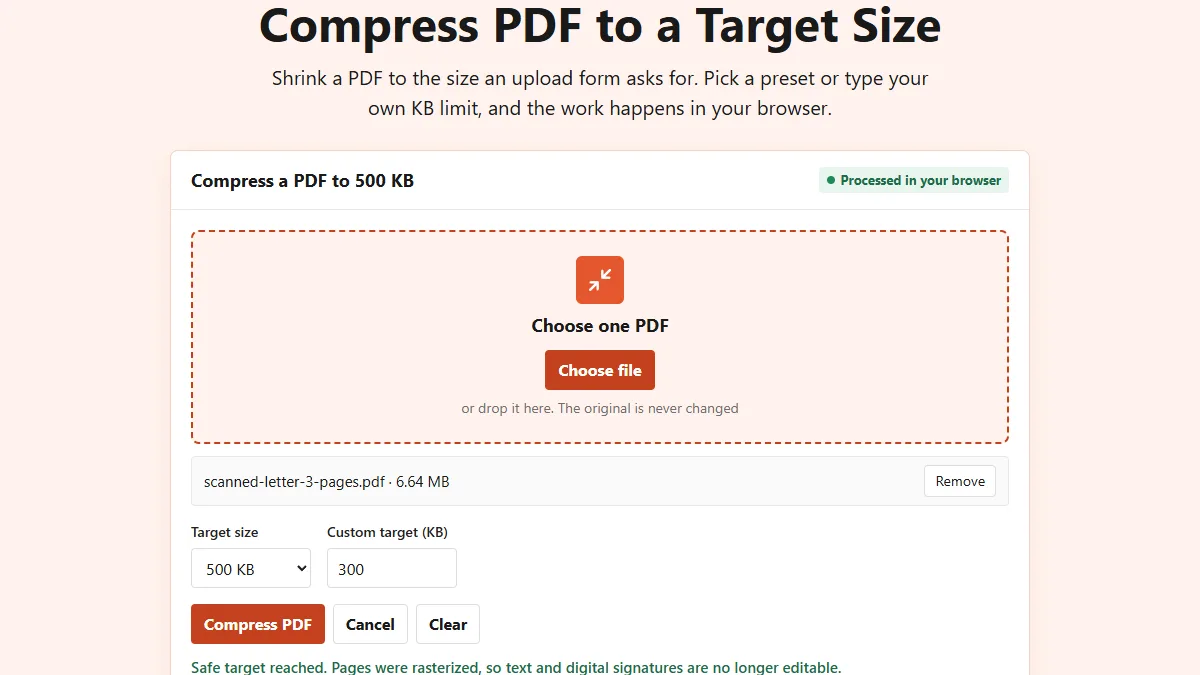
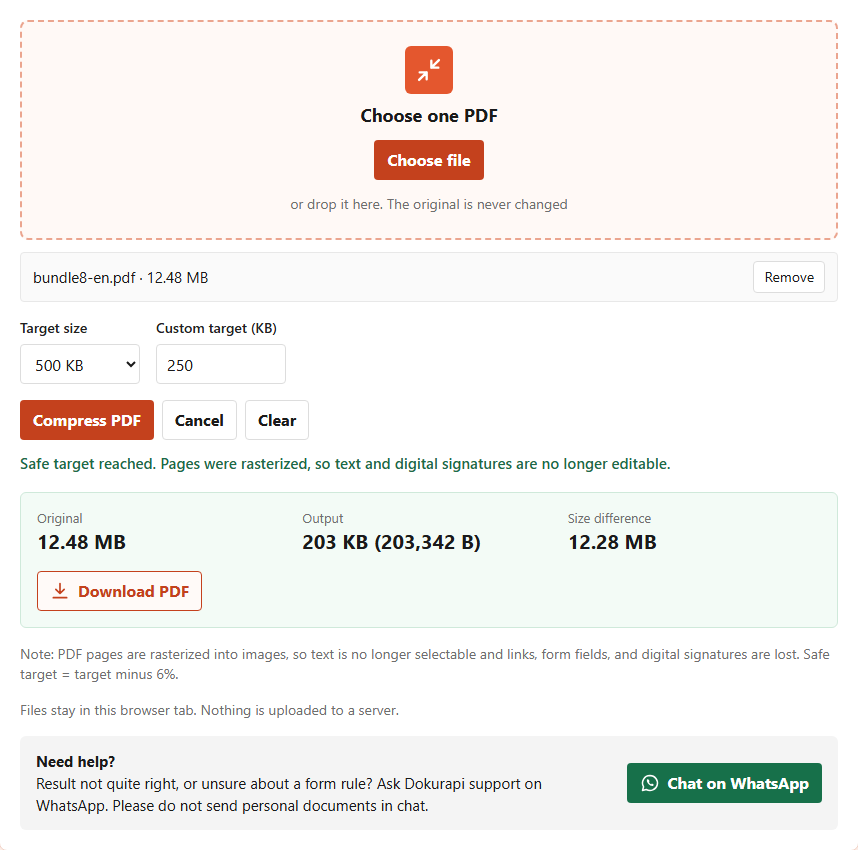
- Type 250 in Custom target (KB). The custom number always overrides the preset list, even if the list still shows 500 KB, as in our screenshots.
- Press Compress PDF. A short file finishes in under two seconds. Our eight page bundle took about 36 seconds and the twelve page bundle about 48, because the tool tried more settings.
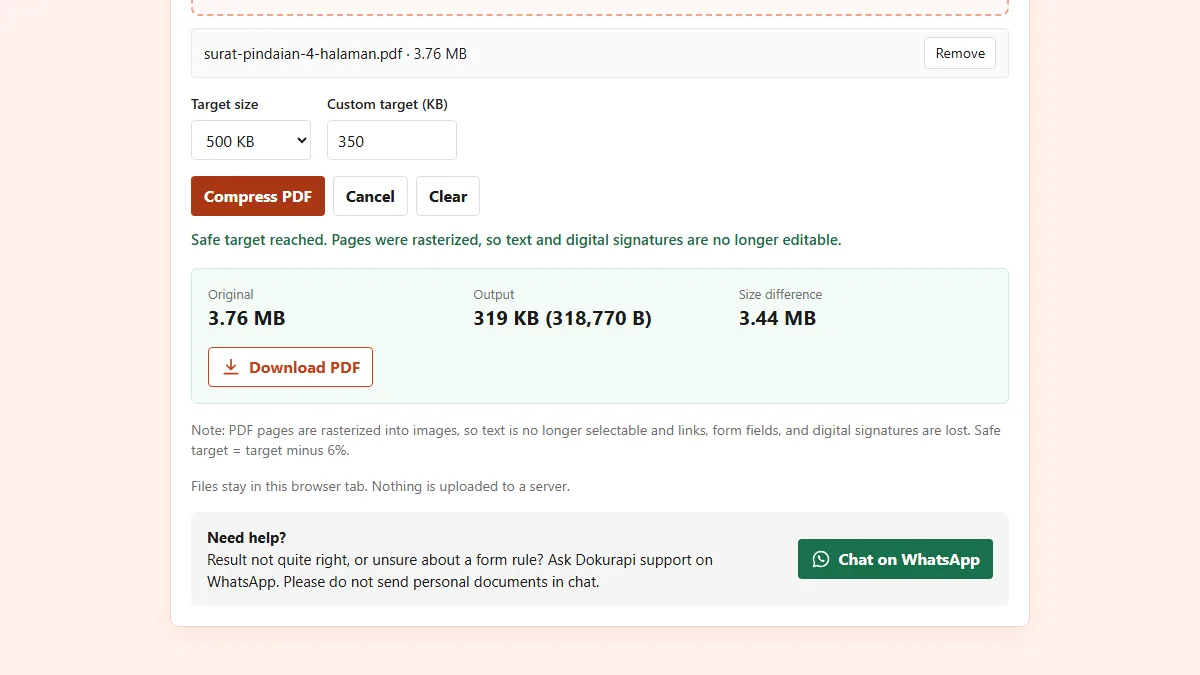
- Read the status line. Green text that says the safe target was reached means 235,000 bytes or less. Grey text that says the target was not reached means you received the smallest version the tool can make.
- Download, open and zoom. Check every page for names, numbers, dates and stamps before you upload it anywhere.
Ready to try it? The tool is free and runs in your browser.
Open the Compress PDF toolHow the tool finds a 250KB version
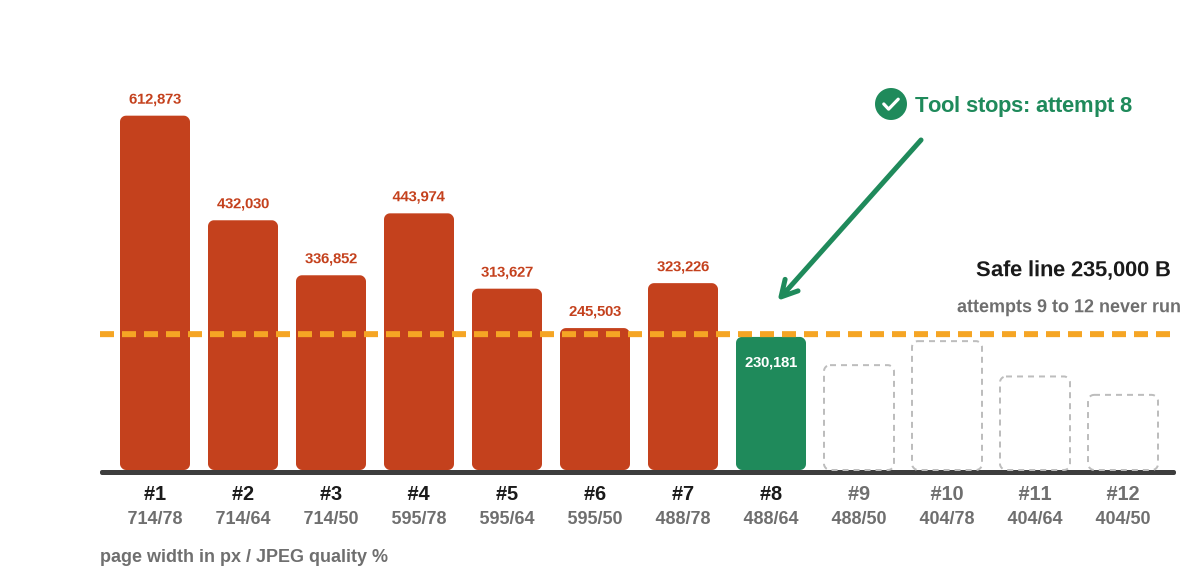
For each attempt the compressor draws every page as an image, saves it as a JPEG, rebuilds the PDF and weighs the result. It has 12 attempts, made of four page widths and three JPEG qualities. The widths are 1.2, 1, 0.82 and 0.68 times the page size, which is 714, 595, 488 and 404 pixels across an A4 page. The qualities are 78%, 64% and 50%, the value passed to the browser's JPEG encoder as described in MDN's toDataURL reference.
The attempts run from sharpest to smallest, and the first one at or under the safe line is kept. For 250 KB the line is 250 x 1,000 x 0.94 = 235,000 bytes. The tool treats 1 KB as 1,000 bytes, the decimal convention that NIST sets out next to the binary one.
The chart below shows the search for our five page application. Attempts 1 to 7 weighed between 612,873 and 245,503 bytes, all too heavy. Attempt 6 missed by only 10,503 bytes, so a cleaner scan might have kept the 595 pixel width. Attempt 8, 488 pixels at 64%, came in at 230,181 bytes and the search stopped. Our guide to compressing a PDF to a specific size explains the same search for any other number you type.
Results from six scanned PDFs
The test files are synthetic scans with no personal data: off white paper, uneven light, scanner grain, a heading and lines of sample text, each page stored as a high quality JPEG inside the PDF. That matches what a phone scanner app or an office copier usually produces. We built an eight page bundle for this test so the gap between five and twelve pages would not be a guess.
| Test file | Original | Result | Attempt kept | Time | Status in the tool |
|---|---|---|---|---|---|
| 1 page form | 1.50 MB | 103,078 B | 1: 714 px, 78% | 0.3 s | Safe target reached |
| 2 page form | 3.07 MB | 226,354 B | 1: 714 px, 78% | 0.4 s | Safe target reached |
| 3 page bundle | 4.69 MB | 202,128 B | 3: 714 px, 50% | 1.8 s | Safe target reached |
| 5 page application | 7.83 MB | 230,181 B | 8: 488 px, 64% | 13 s | Safe target reached |
| 8 page bundle | 12.48 MB | 203,342 B | 12: 404 px, 50% | 36 s | Safe target reached on the last attempt |
| 12 page bundle | 18.72 MB | 304,587 B | 12: 404 px, 50% | 48 s | Target not reached |
The two page form shows what the extra room buys. It kept the sharpest setting at 226,354 bytes, with 8,646 bytes to spare. The eight page bundle is the other end: attempt 11 weighed 254,171 bytes, 19,171 over the line, so only the last and smallest attempt fitted. Times were measured on a laptop and will be longer on an older phone. They grow with the number of pages and the number of attempts, not with anything you can change in the settings.
250KB compared with 150, 200 and 300KB
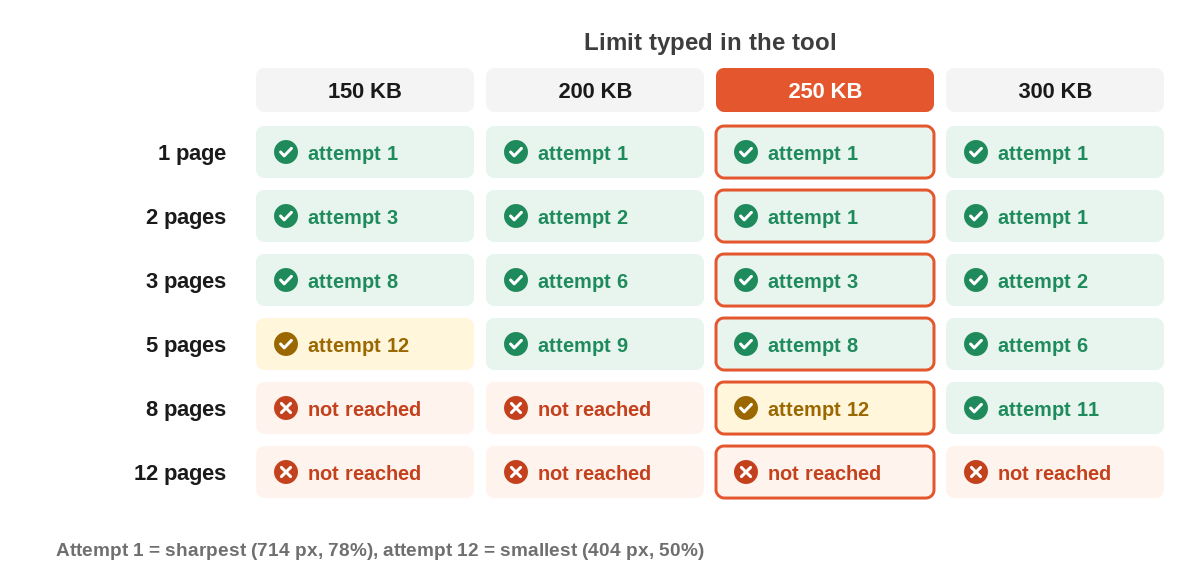
Because the tool records the size of every attempt, we could check what each of the six files would get at other common limits. The grid shows the attempt the tool would keep. A low number means a sharp page, attempt 12 means the smallest setting, and a cross means the file does not fit.
| Test file | 150 KB | 200 KB | 250 KB | 300 KB |
|---|---|---|---|---|
| 1 page | 1 | 1 | 1 | 1 |
| 2 pages | 3 | 2 | 1 | 1 |
| 3 pages | 8 | 6 | 3 | 2 |
| 5 pages | 12 | 9 | 8 | 6 |
| 8 pages | not reached | not reached | 12 | 11 |
| 12 pages | not reached | not reached | not reached | not reached |
Moving from 200 KB to 250 KB lets the three page bundle jump from attempt 6 to attempt 3, which means 714 pixel pages instead of 595. It also turns the eight page bundle from a failure into a pass. At the other end, a single page is already sharp at 150 KB, so a bigger limit changes nothing for it.
How many pages fit in 250KB
A scanned PDF is mostly one image per page, so the safe line is shared between pages. At 250 KB each page of a two page file may use 117,500 bytes, a five page file 47,000 bytes per page, and an eight page file 29,375 bytes. On the smallest setting a page of our test text needed about 25,400 bytes, measured on both the eight and the twelve page bundles.
Divide 235,000 by 25,400 and you get just over nine. So for typical scans, around nine pages is the most that 250 KB can hold with this tool. We did not test a nine page file, so take that as an estimate. Pages with photos, colour stamps, coloured paper or a dark background need more bytes and lower the ceiling. Clean typed pages on white paper need fewer and raise it a little. If your document is close to the ceiling, expect the smallest setting, and check the pages carefully afterwards.
How sharp the pages stay
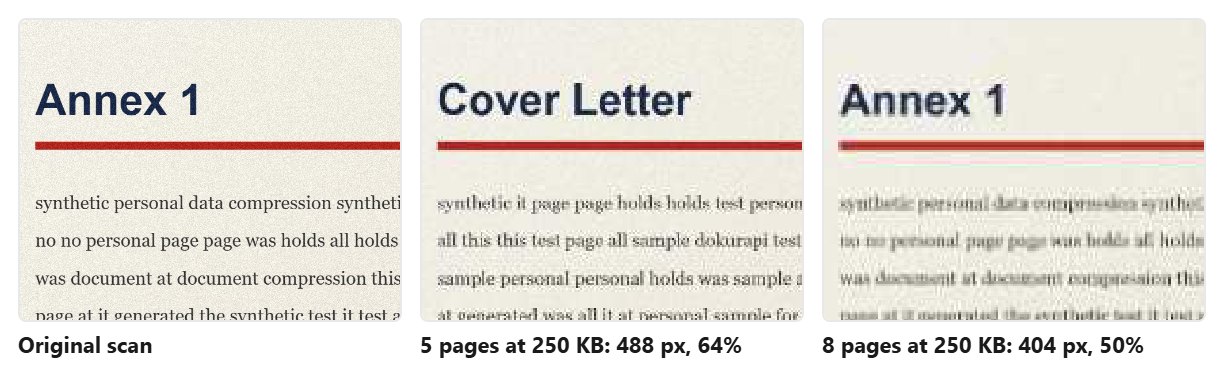
The result depends on how many pages share the budget. Up to three pages, the tool kept 714 pixel pages, which look close to the original on a laptop screen. The five page file dropped to 488 pixels at 64%: still easy to read, with slightly soft letter edges. The eight page file needed 404 pixels at 50%, the lowest the tool goes. Headings stay clear, but normal body text turns blurry and small print becomes hard to read.
The crop below puts these side by side at the same display size. It is the first page of each file, so the heading differs between the five and eight page files. Check your own result at 100% zoom and focus on what a reviewer has to read, such as ID numbers, dates and signatures. If they are hard to make out, a pass on file size is not worth much. In that case splitting the document, explained in the next section, usually beats squeezing all pages into one file.
When the PDF will not go under 250KB
If the status says the target was not reached, the tool has already tried its smallest setting, so trying again changes nothing. The file needs fewer pages or lighter pages. Go through these steps in order:
- Delete pages the form did not ask for. Covers, blank backs and instruction sheets weigh as much as content pages. See how to delete PDF pages.
- Split the document when the portal has several upload fields. Two files of six pages each would both fit at 250 KB. Our split PDF guide shows how, also in the browser.
- Rescan on white paper in grayscale. Shadows, coloured backgrounds and a desk around the page all add bytes. The scanning guide covers light and cropping.
- Confirm whether the limit is per file or per upload. Some forms set 250 KB for one document and a bigger limit for supporting files.
Our twelve page bundle stayed at 304,587 bytes on the smallest setting, about 70,000 bytes too many. Taking out three pages, or splitting it into two files of six pages, would solve that. If the file is still too big after all of this, our checklist for a compressed file that is still too big covers rarer causes such as oversized page dimensions.
250KB, 0.25MB and 256,000 bytes
Upload forms write this limit as 250 KB, 250 kb, 0.25 MB or a byte count. In decimal units 250 KB is 250,000 bytes, which is 0.25 MB. Systems that count 1 KB as 1,024 bytes read 250 KB as 256,000 bytes. The tool's safe line of 235,000 bytes sits under both readings, with room left for portals that round sizes or add a little data when they store a file.
So trust the exact byte figure in the Output line, not the rounded KB value. A result of 230,181 bytes shows as 230 KB and passes whichever way the portal counts. Your file manager can confuse things, because some show sizes in binary units and some in decimal units. When the two disagree, the byte count is the figure that settles it. Our explainer on how KB and MB are counted has more worked examples.
PDFs made in Word or Google Docs
All of the tests above are scans. A PDF exported from Word or Google Docs stores text as text and is often already well under 250 KB. If yours is, the tool says the file is already under the target and suggests keeping the original. Do that, because the text stays sharp, searchable and selectable.
If a text PDF is over 250 KB, the extra weight usually comes from an embedded photo, a large logo or a scanned signature. Rasterizing the whole document to save that weight would blur all the text. It is better to make that image smaller in the source file and export again. Our guide to compressing a PDF without losing quality goes into those options. If you plan to join several files into one upload, read merging PDFs for submissions first, because the merged file is roughly the sum of its parts.
Checklist before you upload
Before you submit, run through a short checklist:
- The Output line shows 235,000 bytes or less, or a number under the limit the form gives.
- Every page opens, in the right order, with nothing blank. Our guide to checking PDF page order lists what to look for.
- Names, numbers and dates are readable at 100% zoom.
- The file name follows the form's rules, since some portals reject spaces or long names.
- The original is saved next to the compressed copy, in case you need to try again with fewer pages.
Keep in mind what compression changed. Pages are now images, so text cannot be selected, and links, form fields and digital signatures are gone. If the portal wants a signed PDF, compress first and sign afterwards. Your document never left your device, as explained in how browser tools work. The same steps work in Chrome or Safari on a phone; see compressing a PDF on a phone for tips.
Frequently asked questions
How do I compress a PDF to 250KB for free?
How many pages fit in a 250KB PDF?
Why is 250KB not in the preset list?
Is 250KB the same as 0.25MB?
Why is my result much smaller than 250KB?
Will the 250KB PDF still look sharp?
Is my PDF uploaded to a server?
What can I do if my PDF stays over 250KB?
Sources
Need help?Result not quite right, or unsure about a form rule? Ask Dokurapi support on WhatsApp. Please do not send personal documents in chat.
Chat on WhatsApp